
Why October
Lisbon in July is a city performing an impression of itself. The trams are full, the miradouros are full, the restaurants have worked out that nobody is coming back, and the whole place runs at the speed of the slowest person in a tour group.
October is when it stops performing and goes back to being a city.
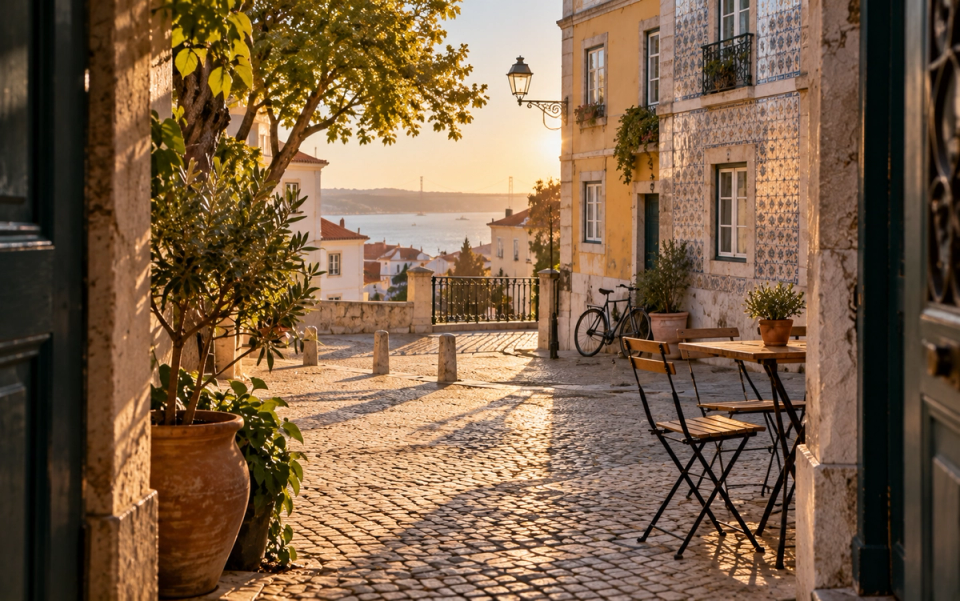
The crowds thin out considerably. The queues shorten to something you'd actually join. Restaurant tables turn at a human pace again, and the people serving you have time to have an opinion. The sea is still warm enough to swim in, the days are still long, and the light — the thing everyone actually comes here for — is at its best.
I'll be honest about the other half of it: October is when the rain starts. Not all week, most years. But it arrives, usually in short sharp bursts rather than a grey wash, and a rainy morning in Lisbon is not a wasted morning. It's a long lunch, a museum, a book, and then the light again by four.
That trade — a bit of rain for a great deal less of everybody else — is the whole argument for going now rather than in August. I'd take it every time.
The light, and why the room matters
Here is the most useful thing I can tell you about booking a hotel in Lisbon: ask which way the room faces.
The city is built on hills on the north bank of a very wide river, and the light bounces off that water in a way that has had people writing about it for centuries. South-facing rooms get the direct sun and, in a shoulder-season month, they get warm — genuinely hot by mid-afternoon, and bright at an hour when you'd rather be asleep.
North-facing rooms get the good light. Soft, even, unglaring, the kind that makes you want to sit still and look at things. If you're the sort of person who notices light — and if you're reading a travel site, you probably are — it's the difference between a room you use and a room you end up spending an hour in.
Most booking sites won't tell you. It's worth asking. It's worth asking about floors, too: the higher up, the better the view, and the better the breeze.
The hills, and what to wear on your feet
Lisbon is not flat, and the postcards do not prepare you for it.
It's built across a series of hills, and the streets between them are either stairs or cobbles, often both, often at an angle you'd describe as ambitious. You will spend the weekend going up and down far more than you expected. This is the charm of the place and also the reason your calves will ache on the second morning.
So: bring shoes with actual grip. This is not a style note. The calçada portuguesa — those beautiful black-and-white mosaics underfoot — is genuinely slippery when wet, and October does wet. Flat, grippy, broken-in. Leave the smooth soles at home.
The hills are worth it, though, and they're the reason the city rewards walking. Alfama in the morning, when the deliveries are happening and the laundry is going up. Graça, up above it, quieter and more residential. Bairro Alto by day, which is a completely different place from Bairro Alto by night. Príncipe Real in the evening, when it's locals and dogs and a drink outside.
And look up as you go. The tiled façades — azulejo, the glazed tiles that cover whole buildings here — are the thing people photograph most and notice least. Patterns in blue and white, some of them three hundred years old, on ordinary residential streets where nobody's selling anything. The city's best feature is the one it hasn't monetised.
Where the crowds aren't
The classic advice is to get up early, and it's correct, but it's worth being specific about where.
The miradouros before nine. Lisbon's viewpoints — Santa Luzia, Senhora do Monte, São Pedro de Alcântara and the rest — are the best thing in the city and get packed from mid-morning. At eight they're empty apart from the man opening the kiosk. Same view, no crowd, and the light is doing its best work.
Feira da Ladra, the flea market, runs on Tuesdays and Saturdays up by the Pantheon. It's mostly junk, occasionally treasure, and entirely untouristed in the way that matters — it's where people go to sell things, not where people go to be seen buying them.
Campo de Ourique and Estrela. Residential, calm, no coach parties. Estrela's gardens are the best place in the city to sit with a book, and Campo de Ourique eats like a neighbourhood rather than a destination.
And what I'd skip. Tram 28 is famously beautiful and famously a pickpocket's office — if you want the experience, take it early or take a different tram on the same route. The Elevador de Santa Justa has a queue that will eat an hour of your weekend to save you a ten-minute walk. Belém is worth it, but go first thing; by eleven the monastery is a scrum.
Eating, without the performance
Two honest things.
First, the famous market hall by the river is fine. It's a food hall, it's well done, and it's priced accordingly — worth an hour if you're nearby and curious, not worth planning a day around. The better eating is in the streets behind it, and in the neighbourhoods above.
Second, the food is better than it's given credit for. This is a city that does extraordinary things with fish, a lot of things with pork, and more with rice than you'd expect. Order the thing you can't pronounce. Ask what's good today, not what's on the menu — if there's a dish the waiter wants to talk about, that's the dish.
Pastéis de nata, obviously. But the good ones come out of the oven at specific times and are best within about ten minutes of doing so, which is a much better reason to walk into a particular shop than a guidebook recommendation.
And ginjinha — sour cherry liqueur, served in a tiny glass, often for less than a euro, from small doorways with no signage. It's a Lisbon institution and it takes ninety seconds. Have one before dinner.
Being left alone
I'll keep this brief, because it isn't the reason to go and shouldn't be.
Lisbon is one of those European cities where you simply aren't an exception. Two men booking a double room is a booking for a double room. Two women, same. A family that doesn't look like the stock photo, same. Nobody performs acceptance at you, and nobody asks a question they shouldn't — which is a much better standard than being loudly welcomed.
That's not one of the headline reasons to go. It's just the baseline you'll find when you get there, and the reason it's on this list at all is that it isn't universal. Plenty of lovely cities manage the welcome and not the baseline.
One day out, done properly
Sintra is forty minutes by train and genuinely extraordinary — but it is also the single most crowded thing near Lisbon, and October only takes the edge off. If you go: book Pena Palace tickets in advance, be on an early train, and treat the whole thing as a half-day rather than a full one.
Cascais, on the other hand, is the one I'd choose. Thirty-five minutes down the coast, a fishing town that turned into a resort without losing its manners. Seafront, decent seafood, a market, and space to walk. Much less effort than Sintra, considerably more relaxing, and the train ride along the river is worth the fare on its own.
Practical notes
- Same time zone as the UK. No adjusting, no jet lag, no lost morning. For a long weekend this is a bigger deal than it sounds.
- About two hours forty-five from most UK airports. You can leave after work on Thursday and be at dinner by nine.
- English is widely spoken, especially by anyone under fifty. Attempting Portuguese is appreciated; not attempting it is not a problem.
- Card is accepted almost everywhere, but carry some cash for ginjinha windows and small tascas.
- Book the big sights in advance. Pena Palace, the Jerónimos monastery, anywhere with a timed entry. October is quieter, not empty.
- Three nights is the right length. Four if you're doing Sintra or Cascais. Two and you'll spend the whole time in transit between the things you meant to do.
The last word
The trick with Lisbon in October is to stop treating it as a list of places and treat it as a city you've got a few days in.
Sleep in a room facing north. Wear shoes that grip. Get up early once, for the viewpoints, and then don't again. Eat where the waiter has an opinion. Walk further than you planned and take the steep way when you can. And when it rains, go inside and have a long lunch, because the light comes back at four and the whole city will be worth it again.
That's a long weekend done well. And it's why I'd send you in October rather than July, every time.